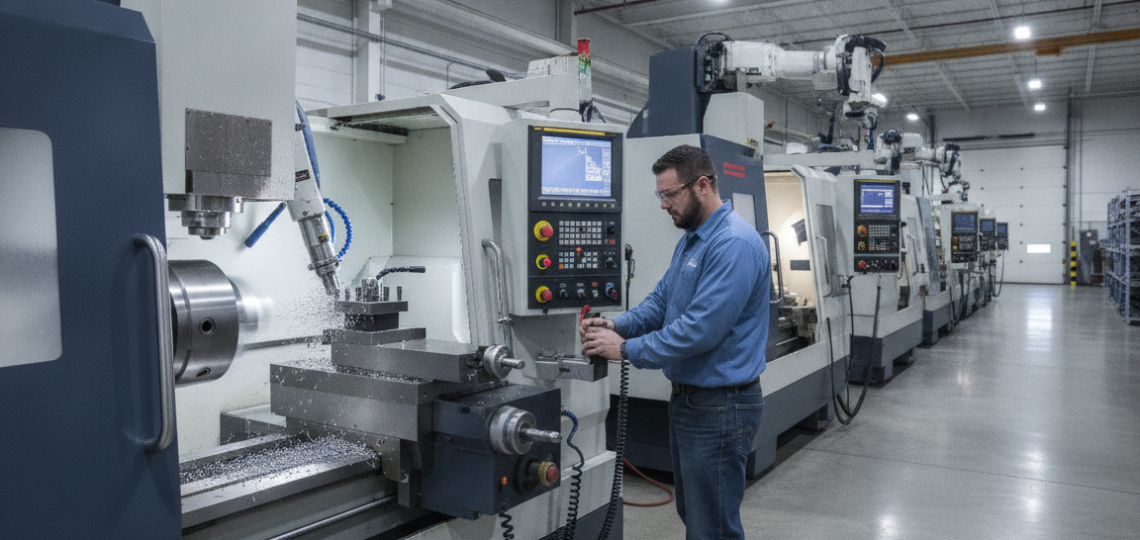
CNC Machine Shop Houston – Advanced CAM Programming for Optimized Toolpaths
Houston’s manufacturing sector attracts procurement managers and design engineers who require accurately produced components. The Texas manufacturing economy accounts for almost 12% of statewide output, reaches about $226 billion in value, and provides employment for close to 900,000 workers. Such a large manufacturing base allows Houston industrial machining services to expand their expertise, capacity, and range of available solutions.
Industrial Machining Services Houston
The following review explores Houston-area machining providers, ranging from locally owned specialists to national precision shops and regional contract-production companies. The companies discussed include Lowrance Machine (www.lowrancemachine.com), RBR Machine, Centerline, and comparable contract-manufacturing providers. These examples illustrate the considerable variety within Houston’s network of machining and manufacturing suppliers.
Product designers and original-equipment manufacturers across energy, aerospace, medical, and industrial markets can use this guide to compare and choose an appropriate machining company in Houston. Covered capabilities include CNC milling, advanced 5-axis work, high-accuracy machining, and end-to-end turnkey manufacturing. Later sections explain available technologies, production capabilities, and supplier-selection criteria so teams can compare providers by tolerance control, turnaround time, and additional value-added services.
Important Findings
- Houston’s extensive industrial base makes it an excellent location for sourcing high-precision machining services.
- The featured suppliers include local specialists, including Lowrance Machine, together with nationwide manufacturers operating in Houston.
- Houston shops offer capabilities ranging from basic milling operations to complex multi-axis machining and end-to-end production.
- Target readers include sourcing managers, design engineers, manufacturing personnel, and original-equipment manufacturers.
- The following sections cover supplier evaluation, pricing considerations, turnaround schedules, and real-world machining applications.
Houston Industrial Machining Services: Market Overview And Industry Context
Increasing demand across oil and gas, aerospace, medical manufacturing, and petrochemical markets has driven notable growth in Houston’s industrial sector. The need for increasingly precise and complex components has encouraged the expansion of Houston machine shops and their available technologies. Proximity to interstate routes, port facilities, and rail infrastructure reduces freight costs while improving lead times for nearby clients.
Texas has a substantial population of experienced machinists and engineers capable of producing advanced parts on three-axis, four-axis, and five-axis machining centres. This expertise enables more parts to be completed in one setup, decreasing cycle duration and making Texas industrial machine shops more productive. Access to experienced local workers supports faster implementation of modern processes and reduces delays associated with hiring specialised employees.
Advanced equipment is a standard feature of daily production within many Houston machining facilities. Five-axis machining enables complicated surfaces to be completed with fewer fixtures and less time spent changing setups. Shops employ wire EDM to produce intricate cuts, narrow openings, and accurate details in hardened or thin conductive parts. With large-bed milling systems, local providers can handle substantial one-piece projects that previously required out-of-state production.
Quality-assurance equipment is just as important as machining equipment when producing critical components. Zeiss CMMs and comparable coordinate-measuring systems frequently support initial sample approval and routine tolerance checks. The resulting inspection data demonstrates that critical parts satisfy required standards through reliable and auditable measurements.
Selecting a local Houston machine shop offers advantages such as simpler communication and faster face-to-face reviews during design, prototyping, and first-article approval. Nearby manufacturers can adjust more rapidly to revised quantities, updated drawings, and accelerated delivery needs. These benefits reduce offshore supply risks and provide both direct local assistance and the marketability associated with made-in-USA production.
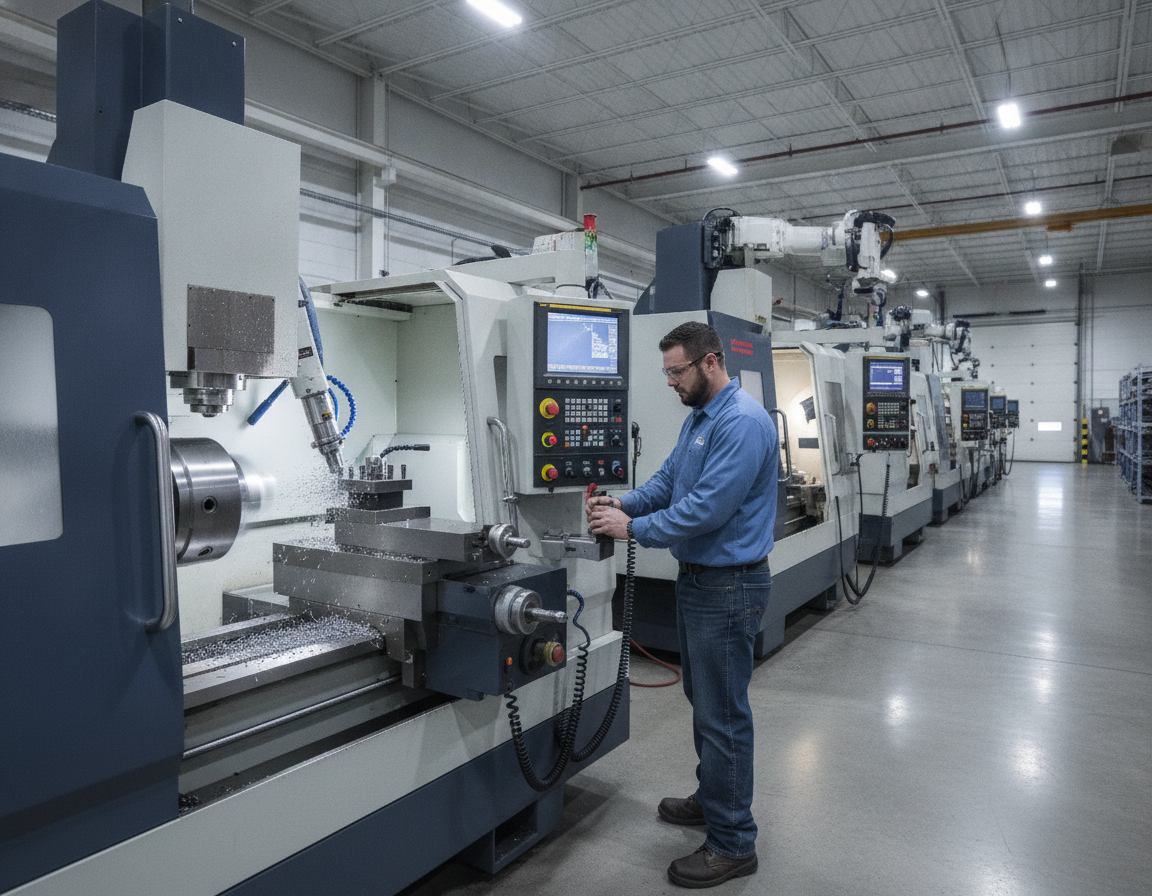 CNC Machine Shop Houston
Top Providers And What Sets Them Apart
Houston’s industrial-machining market combines locally owned companies with specialised regional and national contract manufacturers. Together, these providers offer shorter schedules, more hands-on cooperation, and clearer transportation arrangements than remote vendors. The providers below demonstrate strong CNC capabilities as well as wider industrial-manufacturing services.
Lowrance Machine distinguishes itself through accessible support, direct communication, and strong customer connections. The company performs CNC milling, custom machining, and metal fabrication with an emphasis on rapid turnaround. Because the company operates locally, customers can conduct in-person inspections, coordinate deliveries more easily, and respond quickly to project changes.
RBR Machine focuses on precision manufacturing and advanced five-axis machining across a broad portfolio of services. Its certifications and registrations include ISO 9001:2015, ISO 13485, AS9100D, and ITAR, while its services extend from prototyping to finished assembly. Fast quoting, CMM inspection, API threading, and expedited production allow it to serve oil and gas, aerospace, medical, defence, and similarly demanding industries.
Centerline, together with other area contract-production firms, accommodates projects ranging from small batches to substantial manufacturing runs. Centerline supplies certified domestic manufacturing under ISO 9001:2015 and AS9100D quality systems. Local contract-production firms reduce dependence on distant sources and provide faster, more resilient support for industrial-manufacturing programs.
Choosing between these companies requires consideration of design difficulty, compliance requirements, production volume, and turnaround needs. Work requiring complex 5-axis capability or large machining envelopes often fits providers with resources similar to those of RBR Machine. Lowrance Machine or a comparable local provider may be preferable when quick delivery, regular meetings, and accessible service are priorities.
| Featured Company | Primary Capability | Relevant Certifications | Ideal Application |
|---|---|---|---|
| Lowrance Machine Houston | Houston-based milling, fabrication, and rapid customer assistance | Established manufacturing procedures and in-house quality checks | Short-run projects, urgent schedules, and direct customer involvement |
| RBR Precision Machine | Complex precision machining with large-part and turnkey capabilities | Quality, medical, aerospace, and defence credentials including ISO and ITAR compliance | High-precision aerospace, defence, medical, and oil-and-gas components |
| Centerline Contract Manufacturing | Adaptable manufacturing capacity across small and large production runs | ISO 9001:2015 and AS9100D | Certified domestic production runs and scalable sourcing requirements |
Buyers sourcing CNC machining in Houston should evaluate delivery schedules, measurement capabilities, credentials, cost, and accessibility. Houston-area companies bring together skilled production, responsive service, and supporting manufacturing capabilities for customers in multiple industries.
Capabilities And Services To Look For In A CNC Machine Shop
Finding the right CNC machine shop requires a detailed review of its equipment, quality systems, workforce, and supporting services. A qualified shop should demonstrate rigorous process control, advanced machinery, and complementary capabilities that make sourcing easier. Local businesses that combine precision machining services with metal fabrication and related processing can deliver parts ready for assembly, coating, or final use.
Precision machining services depend on reliable control of dimensional tolerances. Typical tolerances may range from approximately ±0.001 inch to ±0.005 inch, depending on component geometry, material behaviour, and functional requirements. Suppliers working in regulated sectors may provide Zeiss coordinate measurement, FAI documentation, optical checks, NDT, and material-hardness testing. Recognised quality certifications confirm the use of documented systems that simplify customer audits and formal acceptance processes.
For highly toleranced components, independent CMM inspection services can confirm dimensions even when another supplier manufactures the parts. Independent verification provides another layer of confidence without disrupting the established sourcing arrangement.
Advanced machining technologies enable shops to produce intricate shapes while reducing cycle time and unnecessary setups. Five-axis machining in Houston reduces repositioning and setup counts while creating contoured parts used in aerospace, medical, and other precision applications. Wire EDM services in Houston are particularly effective for narrow slots, delicate walls, small radii, and detailed features in conductive materials. Large-format milling handles oversized energy and heavy-equipment components using machine beds that may exceed 100 inches in length and width.
Supporting technologies significantly broaden a shop’s manufacturing capability. Swiss machines excel with slender, detailed pieces, while heavy turning equipment supports substantial shafts and large-diameter work. Houston shops offering milling, turning, and wire EDM together can manage diverse component families without extensive outsourcing.
Turnkey manufacturing can save considerable time and minimise coordination problems between multiple vendors. Comprehensive turnkey services may include engineering support, prototyping, production machining, secondary operations, assembly, finishing, packaging, and logistics. Many local contract firms combine surface coating, anodising, thermal processing, kit preparation, and sourcing administration under a single order.
When schedules are compressed, value-added capabilities become especially important. Expedited scheduling, internal finishing, and in-house assembly reduce supplier handoffs and shorten time-to-market. A supplier integrating machining, fabrication, and turnkey coordination reduces uncertainty over responsibility for final quality.
How To Compare Houston Machine Shops And Choose A Partner
Begin by defining the project requirements in clear and measurable terms. Document anticipated part volumes, specify whether the work is developmental or production-based, and list every required material. Provide dimensional limits, surface-finish specifications, and all applicable regulatory or industry requirements. This level of clarity improves quoting accuracy and lowers the likelihood of late engineering changes or pricing disputes.
Quality certifications and internal procedures should be reviewed carefully before selecting a manufacturer. Determine which recognised standards the shop follows, including ISO, AS9100D, medical-device certification, and defence registration where required. These standards support traceability, process documentation, inspection control, and regulatory acceptance within precision-machining services.
Compare the component design with the machines, software, personnel, and processes available at each shop. Verify the availability of advanced 5-axis equipment, wire electrical-discharge machining, Swiss-style lathes, and oversized milling systems. Inspection resources should include suitable CMM systems, while supplementary offerings may cover heat treat, plating, finishing, and assembly. Reliable Houston machining companies normally publish or provide machine lists, capacity details, and examples of similar completed work.
Compare quotation response times and realistic production lead times before choosing a supplier. Vendors capable of supplying prompt, transparent quotations and genuine rush options may reduce project risk. Fast quoting and clearly stated timelines improve project planning and help control supply-chain uncertainty.
Ask the machining provider to explain its inspection procedures and documentation practices. Request CMM reports, First Article Inspection procedures, raw-material certificates, and dimensional-inspection records. A reputable industrial machine shop Texas provider should supply documentation that supports audits, approvals, and regulatory compliance.
The ability to communicate quickly and obtain nearby technical assistance can materially affect project success. Nearby facilities allow customers to conduct reviews, inspect progress, and address production concerns without major travel or freight delays. A regional supplier often offers better supply-chain adaptability and quicker support for unexpected requirements.
Evaluate local and overseas quotations using total acquisition cost rather than unit price alone. The analysis should cover transportation, tariffs, stock requirements, lead-time exposure, rework, and change-order charges. Once hidden costs and market-launch timing are considered, custom machining from nearby shops may prove more economical than overseas alternatives.
Examine references, case studies, and the supplier’s history within relevant industries. Prior experience in your industry can indicate that the shop understands common materials, standards, and production challenges. Request evidence of comparable part complexity and dependable on-time delivery under actual production conditions.
Determine whether the supplier can support the project after initial delivery and expand production when demand grows. The company should be able to move from development samples to sustained production and, where required, complete assembly or contract manufacturing. Scalable production capability avoids disruption and conserves resources as customer demand expands.
Supplier comparisons become more consistent when teams score technical specifications, quality credentials, machinery, quoting, documentation, support, cost, history, and production scalability. This disciplined approach improves the likelihood of selecting a Houston machining partner that satisfies both engineering and commercial objectives.
Cost, Lead Times, And Real-World Use Cases For Houston Industrial Machining
Several variables influence Houston machining rates, including geometry, raw material, setup requirements, and batch quantity. Costs also rise when parts require extremely close tolerances, specialised inspection, thermal processing, or surface finishing. Intricate geometries and challenging alloys, including titanium, often require slower cutting, specialised tooling, and higher rates. The initial preparation for 5-axis work may be more expensive, yet reduced fixture use and setup time can deliver lower total machining costs.
Budgeting should consider the quoted unit price together with all indirect and supporting expenses. Additional costs may include communication time, freight, tariffs, inventory, quality problems, and schedule delays. Domestic sourcing frequently limits transportation, inventory, and coordination expenses associated with distant suppliers.
Lead times for Houston machining depend on supplier workload, part difficulty, material availability, and the overall project scope. Fast-estimating shops with genuine rush capacity can reduce prototype delays and bring production launches forward. Nearby machining reduces transportation complexity and allows projects to progress without the extended shipping associated with overseas suppliers. Being close to the supplier makes it easier to implement drawing changes, replace rejected parts, and respond to sudden demand.
Work subject to strict industry requirements should be placed with shops maintaining formal quality credentials and coordinate-measurement resources. Documented controls and dependable inspection help prevent quality failures that could disrupt schedules or increase expense.
Real-world projects reveal how Houston machine shops support numerous demanding industries. Energy-sector work may involve oversized mills, rugged materials, API-related features, and components built for severe operating conditions. Aviation and defence components often depend on advanced multi-axis equipment, aerospace certification, traceability, and rigorous measurement. Healthcare components may require delicate EDM features, small-diameter turning, medical-quality certification, and documented lot control. Renewable-energy and power-generation projects may require large-format milling, durable materials, and robust protective finishing.
Machining companies capable of both fast development work and complete manufacturing simplify the path from idea to finished product. They can transfer designs from proof-of-concept through pilot production and full manufacturing while minimising supplier handoffs.
Houston shops with established quality programs and advanced inspection capability are often the safest choice for rush or regulated components. Components with intricate contours benefit from manufacturers that have demonstrated 5-axis expertise and robust programming support. Contract-production companies can be advantageous when quantities vary or when ongoing manufacturing capacity is required. A sourcing strategy that uses a responsive local shop like Lowrance Machine together with specialist regional capabilities can optimise price, lead time, and engineering performance.